
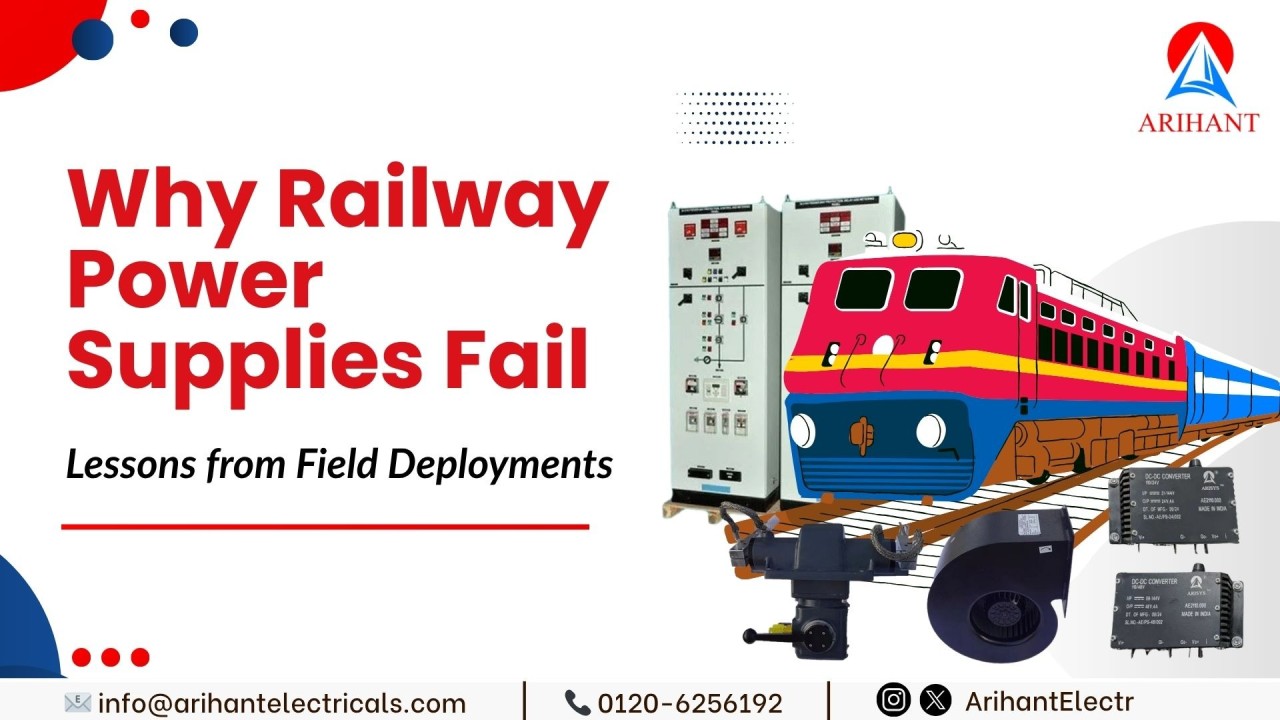
A railway power supply doesn’t fail in the lab. It fails in the real world, under vibration, voltage surges, dust, heat, and nonstop operations.
And in railways, even a small power disruption can trigger communication failures, control system interruptions, delayed operations, or costly maintenance downtime.
Here’s a fact worth thinking about:
Modern locomotives and metro systems can experience continuous voltage fluctuations, transient spikes, and regenerative braking disturbances, putting immense stress on onboard power electronics. A power supply that isn’t railway-grade may perform in testing, but struggle in deployment.
So, what actually causes failures in the field?
⚡ Voltage Surges & Electrical Transients Sudden fluctuations can impact critical systems like onboard electronics, signaling interfaces, communication units, and control panels. This is why rugged 110V/24V & 110V/48V DC-DC converters with surge protection are essential in railway applications.
🌡️ Heat: The Silent System Killer Railway electrical cabinets operate in confined environments with continuous loads. Poor thermal management gradually reduces efficiency, accelerates component wear, and shortens equipment life.
🔩 Harsh Railway Environments Unlike factory testing conditions, railway systems face constant vibration, humidity, dust, and temperature extremes. Components that are not ruggedized often experience premature failures.
🛠️ Serviceability & Downtime Challenges In railways, maintenance windows are limited. Complex power systems increase downtime, making modular, easy-to-maintain battery chargers, control & relay panels, and power conversion systems increasingly critical.
The biggest lesson from field deployments? Railway reliability is not achieved by specifications alone, it is earned through field-proven engineering.
At Arihant Electricals, we engineer railway power solutions with real operating conditions in mind, from DC-DC converters and battery chargers to control panels and customized power electronics built for demanding railway and metro environments.
Because in railways, power failure is never just a technical issue, it’s an operational risk.
Conclusion:
The biggest takeaway? Railway reliability is built for real-world performance, not just technical specifications. In an environment where every second matters, power solutions must be rugged, efficient, and field-proven to withstand demanding operating conditions. Because in railways, reliable power is not just about performance, it’s about uninterrupted operations.