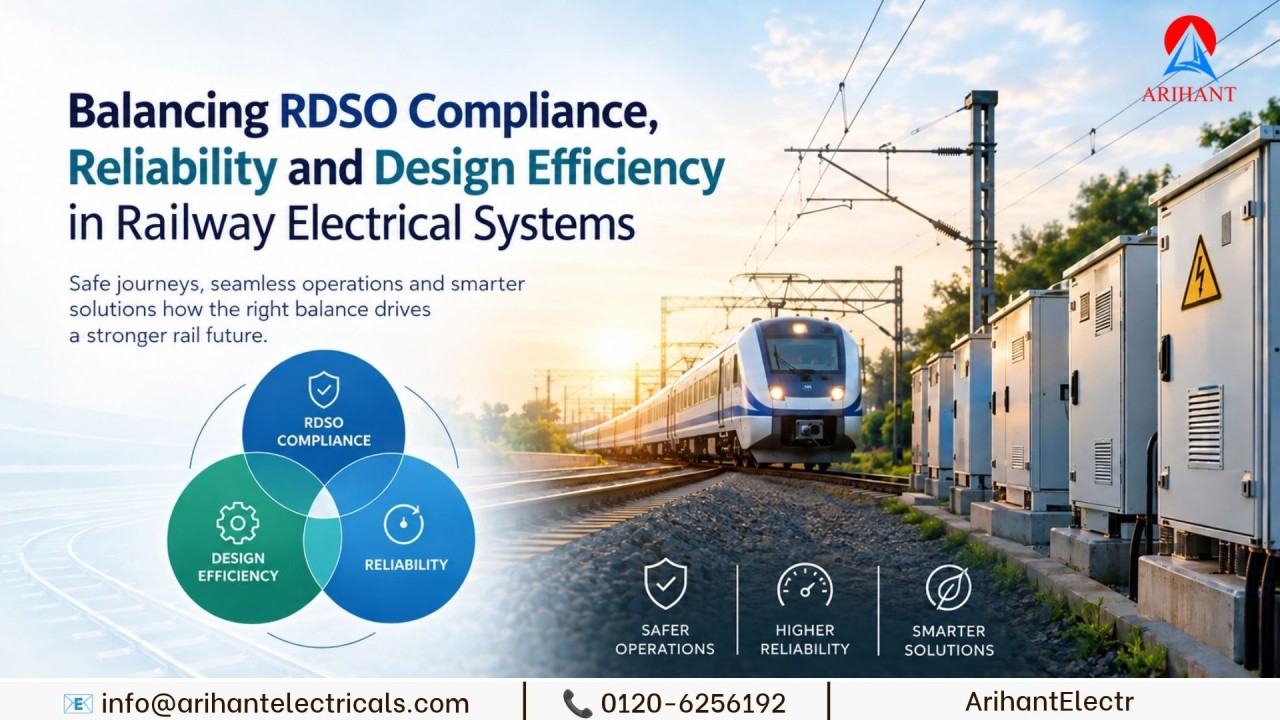
In railway applications, electrical systems must perform reliably under demanding operating conditions. They need to meet stringent safety and performance requirements while also being efficient, practical, and suitable for integration into complex railway systems.
This is where RDSO standards play an important role.
For manufacturers and solution providers, compliance with RDSO requirements is not simply about meeting a checklist. It involves understanding the technical requirements at the design stage and developing products that deliver reliability, safety, efficiency, and long-term performance.
Understanding the Importance of RDSO Standards
The Research Designs & Standards Organisation (RDSO) establishes technical standards and specifications for various railway equipment and systems in India.
These standards help ensure that railway products consistently meet required levels of:
● Safety and operational reliability
● Electrical and mechanical performance
● Environmental endurance
● Quality and durability
● Compatibility with railway systems
● Testing and validation requirements
For electrical equipment used in railway applications, meeting these requirements is particularly important because even a small failure can affect system availability, maintenance schedules, and overall operational efficiency.
Compliance Should Begin at the Design Stage
One of the biggest challenges in developing railway electrical products is ensuring that compliance is considered from the beginning rather than treated as a final-stage activity.
Design teams need to evaluate applicable RDSO specifications while defining the product architecture, selecting components, developing protection mechanisms, and determining electrical and mechanical parameters.
This approach helps identify potential compliance gaps early and reduces the need for major design changes later.
A well-planned design process can therefore support both standards compliance and engineering efficiency.
Designing for Performance, Not Just Compliance
Meeting a standard is an essential requirement, but a railway electrical product must also perform effectively in real-world conditions.
Factors such as voltage fluctuations, temperature variations, vibration, electrical noise, dust, humidity, and continuous operating cycles can influence equipment performance.
Therefore, product design needs to consider:
Thermal Management Efficient heat dissipation helps maintain stable performance and improves component life.
Electrical Protection Appropriate protection against overloads, short circuits, surges, and other electrical disturbances helps improve system reliability.
Component Selection Choosing components with suitable ratings, quality, and operating margins can contribute significantly to long-term performance.
Mechanical Design Robust construction and suitable mounting arrangements help equipment withstand vibration and mechanical stresses associated with railway environments.
Maintainability Designs that allow easier inspection, troubleshooting, and replacement can help reduce maintenance time and operational disruptions.
Optimising Design Without Compromising Standards
A common misconception is that compliance necessarily leads to complex or inefficient designs.
In reality, thoughtful engineering can help achieve both objectives.
Design optimisation may involve reducing unnecessary components, improving circuit layouts, selecting appropriate protection systems, optimising thermal performance, and creating compact architectures without affecting the required safety and performance parameters.
The objective is not to design around the standard, but to design intelligently within the standard.
This requires close collaboration between engineering, quality, testing, and manufacturing teams.
Testing and Validation: Turning Design Into Reliability
Design validation is an important part of developing railway electrical equipment.
Testing helps verify whether the product performs as intended and continues to meet applicable requirements under specified operating and environmental conditions.
Depending on the product and applicable specifications, validation may involve evaluating parameters such as:
● Electrical performance
● Insulation and dielectric strength
● Temperature performance
● Protection characteristics
● Vibration and mechanical endurance
● Environmental performance
● Electromagnetic compatibility
● Long-duration operational reliability
A structured testing approach provides valuable feedback to the design team and helps strengthen the product before deployment.
Building Reliability Into Every Stage
RDSO compliance should not be viewed as a one-time certification objective. It should be supported by consistent quality practices throughout the product lifecycle.
From engineering and procurement to manufacturing, testing, inspection, and final delivery, every stage contributes to the reliability of the final product.
For railway electrical manufacturers, this means establishing strong processes for:
● Design control
● Component quality
● Manufacturing consistency
● Inspection and testing
● Traceability
● Documentation
● Continuous improvement
Such an approach helps create products that are not only compliant on paper but also dependable in actual railway applications.
The Way Forward
As India’s railway network continues to modernise, the demand for reliable and efficient electrical systems will continue to grow. New technologies, higher system requirements, and increasing emphasis on safety and operational efficiency will make engineering excellence even more important.
The future of railway electrical design lies in finding the right balance between compliance, performance, efficiency, reliability, and maintainability.
For manufacturers, the goal should be simple: develop solutions that meet the required standards while delivering practical value in the field.
Because in railway applications, true engineering efficiency is not about compromising on requirements. It is about meeting them through smarter design, stronger validation, and consistent quality.