

A Battery Management System (BMS) is responsible for overseeing and managing a battery or battery pack. It protects the battery from operating outside safe limits by monitoring, controlling, and safeguarding individual cells or modules, especially lithium-ion (Li-ion) cells. BMS is critical for ensuring safety, performance, and longevity in devices ranging from consumer electronics to electric vehicles.
At Arihant Electricals, we prioritise safety, reliability, and efficiency in battery systems. Our advanced BMS solutions seamlessly integrate electrical and thermal protection, enabling industries to achieve optimal performance across a wide range of applications.
Core functions of BMS
The term “battery” implies the entire pack; however, the monitoring and control functions are specifically applied to individual cells, or groups of cells called modules, in the overall battery pack assembly. Lithium-ion rechargeable cells have the highest energy density and are the standard choice for battery packs for many consumer products, from laptops to electric vehicles.
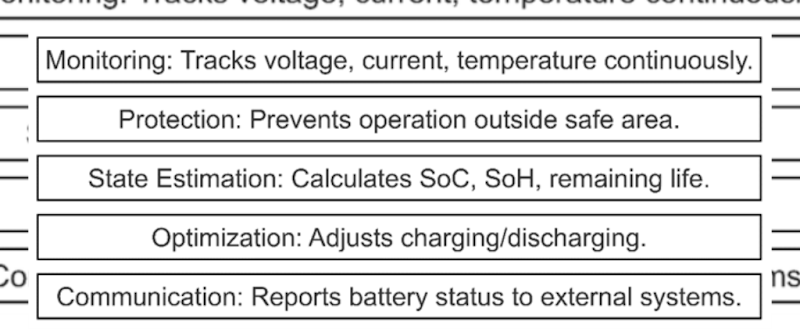
How Do Battery Management Systems Work?
Battery pack protection management has two key arenas: electrical protection, which implies not allowing the battery to be damaged via usage outside its SOA, and thermal protection, which involves passive and/or active temperature control to maintain or bring the pack into its SOA.
a. Electrical Management Protection: Current
- BMS monitors continuous and peak charging/discharging currents.
- Allows short peak currents (e.g., EV acceleration) but prevents prolonged overload.
- Detects sudden current spikes (e.g., short circuits) and can interrupt current flow instantly.
b. Electrical Management Protection: Voltage
- Maintains cell voltage within safe limits during charge and discharge cycles.
- Voltage limits vary with temperature and the type of battery chemistry.
- Prevents overcharging and deep discharging, both of which are harmful to battery health.

c. Thermal Management Protection: Temperature
- BMS integrates passive (heat sinks) and active (cooling fans/liquid cooling) thermal controls.
- Maintains temperature within SOA to prevent thermal runaway or capacity loss.
- Thermal data is critical for adjusting charging rates and protecting cells.
d. Safe Operating Area (SOA) of Lithium-Ion Cells
The state of charge (SOC) of a cell or module at a given time is proportional to the charge available relative to the total charge when fully charged. Thus, a battery at 50% SOC implies it is 50% charged, which is akin to a fuel gauge’s figure of merit. BMS capacity management is all about balancing the variation of the SOC across each stack in the pack assembly. Since the SOC is not a directly measurable quantity, it can be estimated by various techniques, and the balancing scheme itself generally falls into two main categories, passive and active.
- Lithium-ion cells have strict voltage and current limits for safe operation.
- SOA boundaries depend on cell chemistry and temperature.
- Operating outside SOA risks performance degradation or dangerous failures.
Why Battery Management Systems Matter
The complexity of a BMS depends on factors like battery size, application, and safety requirements. It must meet regulatory standards while balancing cost, size, and performance, especially across consumer electronics and automotive sectors.
At Arihant Electricals, we offer advanced BMS solutions that integrate electrical, thermal, and control technologies. Focused on safety, efficiency, and innovation, we help industries maximise the potential of battery systems across automotive and industrial applications.
Disclaimer: The information provided in this article is for general informational purposes only. Product specifications and features may vary based on specific requirements. For detailed information and customized solutions, please contact Arihant Electricals directly.