
In an era where intelligent sensing defines the performance and safety of electrical and electronic systems, Hall-effect Integrated Circuits (ICs) have become indispensable. At Arihant Electricals, these components play a vital role in enabling advanced control, automation, and protection across industrial, EV, power electronics, and consumer applications.
What Makes Hall-Effect ICs Special?
Hall-effect ICs are semiconductor devices that detect magnetic fields and convert them into electrical signals. Using a Hall sensing element combined with amplification and processing circuits, these ICs deliver:
- Non-contact sensing
- Excellent electrical isolation
- High reliability in harsh conditions
- Analog or digital outputs depending on application needs
This unique combination makes them ideal for motion, position, and current sensing applications.
How Hall-Effect ICs Work
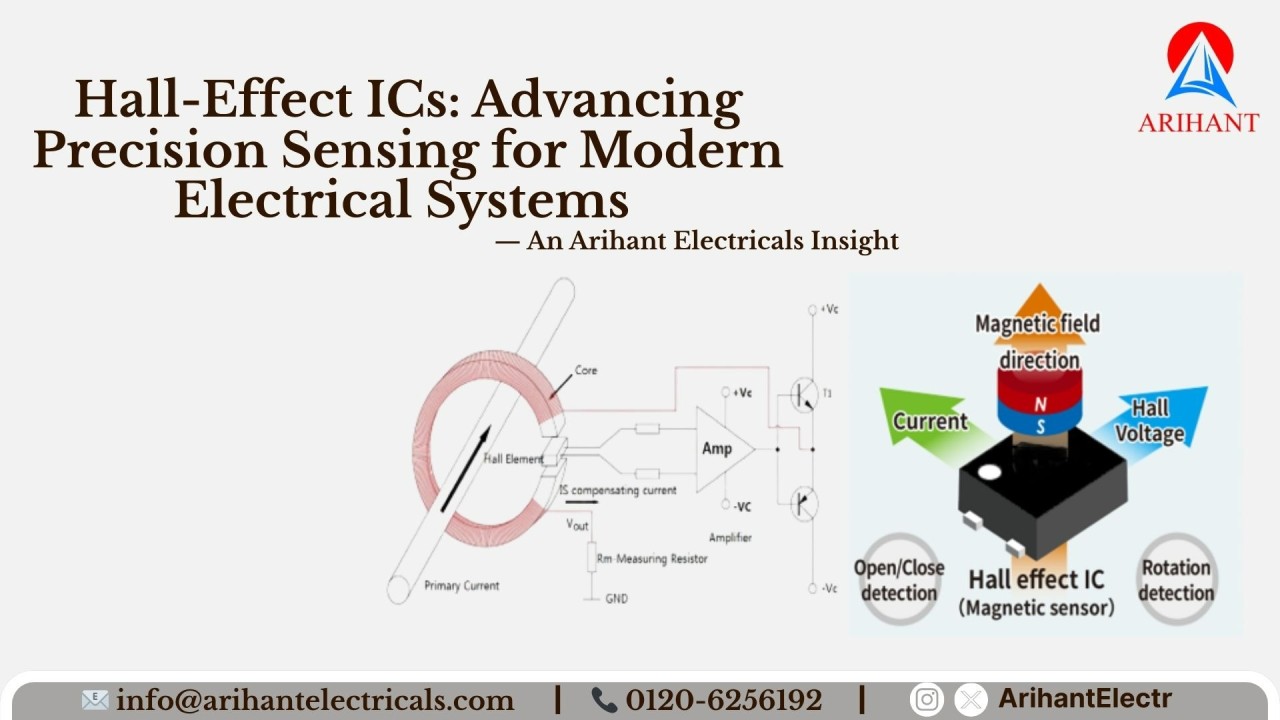
When current flows through the Hall element and a perpendicular magnetic field is applied, a small Hall voltage is generated. This voltage is amplified within the IC by an amplified circuitry to produce a usable signal.
Depending on functionality, Hall ICs behave as:
- Linear sensors, where output varies with magnetic field strength
- Switches or latches, triggered by crossing magnetic thresholds
Mechanical design—including magnet placement and orientation—plays a crucial role in achieving precise results, as “most Hall-effect sensor data sheets specify the expected direction of the magnetic field relative to the package surface.”.
Current Sensing Using Hall ICs
Hall-based current sensors are widely used for AC and DC measurement, offering galvanic isolation and robustness.
Two common methods include:
Open-Loop Sensing
- Simple and compact
- Moderately accurate
- Suitable for cost-sensitive applications
Closed-Loop Sensing
- Uses secondary winding to actively cancel magnetic flux
- Offers high accuracy, low drift, and superior stability
- Preferred for EV chargers, industrial drives, and high-precision power supplies
Modern Hall current sensors now provide high isolation ratings and reliable performance under dynamic load conditions.
Types of Hall ICs
By Output
- Switch: ON/OFF responses
- Latch: Holds magnetic state
- Linear: Proportional field measurement
By Magnetic Behavior
- Unipolar, Bipolar, Omnipolar
- Zero-cross latches for polarity-sensitive systems
Where Arihant Electricals Uses Hall IC Technology
Hall ICs are integral to multiple Arihant Electricals solutions, including:
- BLDC motor control systems
- Railway & industrial automation sensing modules
- High-voltage power electronics and protection units
- EV components and battery management systems
- Consumer-grade sensor assemblies
Their high durability and isolation characteristics make them ideal for mission-critical environments such as railways, aerospace, renewable energy, and defense—key sectors where Arihant delivers innovative, reliable products.
Design Best Practices Followed at Arihant
To ensure optimal performance in real-world applications, Arihant Electricals emphasizes:
- Correct magnet orientation and air-gap design
- High-isolation architecture for HV environments
- Temperature-compensated sensors to minimize drift
- Selecting appropriate bandwidth for system frequency
- Robust packaging for long-term durability
Conclusion
Hall-effect ICs form the backbone of precise, reliable, and isolated sensing across industries. Their versatility and effective use in circuits enables Arihant Electricals to engineer smarter, safer, and more efficient solutions for modern electrical infrastructure. As technology advances, Hall ICs will continue to drive innovation in current sensing, automation, EVs, and intelligent control systems.
Disclaimer: This article is intended for informational purposes only and does not constitute engineering advice. All technical references are based on current available data and are subject to change. Product names, brands, and data cited remain the property of their respective owners.