The Solid State Transformer (SST) has been gaining tremendous attention, both in academia and industry, promising extraordinary (often hyped) power conversion performances, well beyond the current state of the art converters. Despite well-evidenced efforts, SST as a technology is still somewhat struggling to gain commercial traction and find its place on the market.
An emerging conversion technology
1. The Solid State Transformer (SST), as a new and emerging power electronic conversion technology, is aiming to achieve the same power conversion in various AC or DC power systems, industrial, data centres, and e-mobility infrastructure applications. Numerous demonstrators and prototypes have been presented over the last twenty years or more, yet without a significant commercial breakthrough, which would establish the SST on the market as the primary power electronic conversion technology of choice.
What are solid state transformers?
1. The word transformer inside the SST name leads to a lot of confusion, unfortunately. Despite various topological variations that exist, the SST is essentially a galvanically isolated modular converter. It has power electronic conversion stages at its terminals, regardless of their number (two or more) and type (AC or DC), and the galvanic isolation is achieved with a plurality of integrated high-frequency transformers (HFTs), operated at several tens or hundreds of kHz.
2. Typically, the SST is a highly modular converter made from many low-power-rated building blocks or modules. It can be designed to perform any conversion: AC-DC, DC-AC, AC-AC, DC-DC, with multiple terminals and with arbitrary numbers of AC phases, even though the single-phase and three-phase AC networks are of practical relevance.
SST architecture
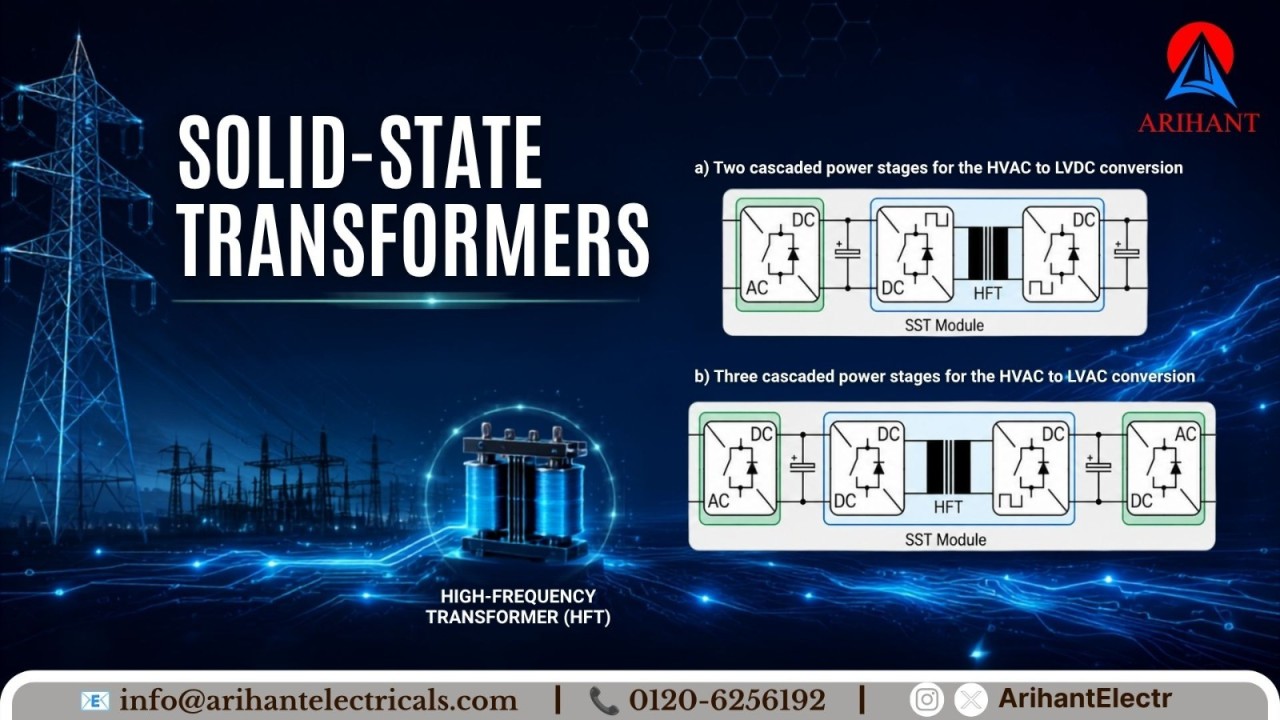
a) The generic SST module is typically composed of: a) two cascaded power stages for the MVAC to LVDC conversion

b) Three cascaded power stages for the MVAC to LVAC conversion

SST Technology Challenges
There are several technical reasons for this, which are related to the internal architecture of SST, requiring a careful engineering design approach and, in some cases, even further research efforts. Realising the MV-rated converter, with the limited blocking voltages of available semiconductor devices, naturally leads to modular SST designs.
Each module contains
a. One or more power electronics stages that are mechanically enclosed and electrically and thermally managed;
b. Various signal-level electronics, including gate drivers, sensors, and local controllers;
c. An auxiliary power supply (internal or external) and communication interfaces with adequate isolation capabilities;
d. A high-frequency transformer (HFT), where applicable.
There are several interfaces that must be managed at the SST module level, including:
- Electrical interfaces (power transfer)
- Thermal interfaces (cooling and heat dissipation)
- Mechanical interfaces (system integration and structural support)
- Communication interfaces (signal transmission and control)
- Auxiliary power interfaces (when an external auxiliary power supply is used)
Even if a single SST module is of modest complexity, many of them need to be mechanically arranged, interfaced, and precisely time-coordinated during normal operation and under fault conditions.
Reliability, availability, redundancy
1. A high number of SST modules equipped with power semiconductors, gate drivers, sensors, capacitors, inductors, auxiliary electronic circuits, etc., results in challenges to ensure high reliability indices.
2. Implementing redundancy inside the SST brings new design challenges, as for redundancy to work, all SST modules must be equipped with means to be bypassed and isolated from the rest of the SST in case any of them is faulty.
High frequency transformers
1. One of the key features distinguishing SST technologies is the presence of the high-power HFTs, providing galvanic isolation and voltage adaptation inside the SST DC-DC module. Even if voltages applied to the winding of these HFTs are small (e.g. ±1500 or ±800V), the isolation design between windings must be carried out considering AC grid working voltages and suitable standards for the insulation coordination to ensure safety in operation. This is proving to be challenging for several reasons.
2. The expectations to greatly reduce the size of HFT by simply increasing its operating frequency are quickly challenged by isolation distances needed to ensure safety, hence further increasing the switching frequency only increases the losses and impairs the SST efficiency.
Efficiency
SST efficiency is not a random outcome of the design, but a key requirement that will increasingly be imposed by applications and customers as SST technology gains wider acceptance. For SST technologies, efficiency targets are set at 98.5% and above for the complete SST system.
Exciting times are ahead, SST technology is here and becoming a reality now!